Friday, 19 February 2010

Lecture 11 - Over 50's Marketing

Benady, D (2010) states that:

"Growing older is getting cooler, according to the advertising industry. As those who (mis) spent their youths in the late Seventies hit the "big five-oh", marketers are wondering how brands can target this new wave of oldies".

To myself, this statement seems so untrue; who ever thinks they are cooler the older they get. NOT ME!! :) But there must be reasons for this. This advert is directly targeted at the over 50 generation.


The over 50 generation are an increasingly powerful group. Owning 80% of the UK's wealth. This adult generation's population are dramatically increasing and by 2020 they will make up more than half the adult population. Marketeers and advertisers adore this group as it makes advertising easy for them. It is said that the most brands are successful when they learn to grow up alongside their consumers. Thus keeping their brand loyalty.

However, they have only just started avoiding the pitfall of regarding all over 50's as the same. Nowadays; they are split into 5 main groups:


  • Home is where the heart is (3.9 million)
  • You cant take it with you (5.1 million)
  • It's time to enjoy (3.2 million)
  • Mind, body & soul (3.8 million)
  • Secure and sophisticated (4 million)
Home is where the heart is

This group like the simple things, they like to have a nice family life and life a comfortable lifestyle. Here is a few facts and figures about this type of over 50: 64% are female, with an average age of 71, 51% are married, 33% are widowed, 79% are retired, and have a median household income of £11,500. This group think highly of their personal principles and rules - suggesting that they follow a very structured way of life. This is then closely followed by the environment and ethics and cultural outgoings. They have great amounts of respect for and trust in institutions, including brands.There summary profile can be shown below.

As like any other generation, home is where the heart is have their own leisure pursuits. This includes activities such as: bingo and watching television. As you can see these are activities that are generally done within the comfort of their home. They are less likely to eat out a restaurants and use the internet.

Here is a list of their favourite brands:

Secure and sophisticated

The secure and sophisticated group are the people who feel like they have fulfilled all they wanted to in life, and now have no money troubles with a much higher income then the 'home is where the heart is' group.

Here is a few facts and figures of the secure and sophisticated group: 75% male, have an average age of 63, 81% are married, 38% still working, 77% are in the ABC1 class, 22% are more likely to live in the middle east, and have a median household income of £25,000.

These people are still financially active, making higher income work for themselves. They like to take on financial burdens which are traditionally done by the welfare state. This group are highly interested in adopting new technology - especially through the use of the internet. As well as being keen in keeping fit and staying healthy.

Below is their Demographic Profile:


The secure and sophisticated tend to buy into brands such as: Bupa, Pc World, Marks and Spencer, Natwest, Visa, Google, Visa, Dell, Halfords and HSBC.

Traditional Attitudes of over 50's

Many people over the age of 50 tend to buy certain types of products, this may be due to different events that has happened within their lifestyle such as the world war 11. Their particular affinity includes:
FOOD: Ice cream, crackers, sweet biscuits, artificial sweeteners, soups, bread, cakes, frozen fish, and stock and gravy.


FINANCE: Life insurance, buildings and contents insurance, premium bonds, NSI bonds, stocks and shares, unit trusts, and ISAs/PEPs.


DRINKS: Any traditional alcohol, tea, fresh coffee, and milk.


Health & Pharmaceuticals: Vitamins and supplements, Rheumatism, and Arthritis remedies.


Leisure & Holidays: they tend to take more organised holidays, coach trips, castles/ stately homes, plays/classical concerts/ballet, trust membership and bingo


There top media are:

TV: BBC News, Antique Roadshow, Heatbeat, Miss Maple, Who wants to be a millionaire?, Baragin hunt, Natural World, and Gardeners World.


PRESS: Daily Mail, Daily Telegraph, Saga Magazine, Birds Magazine, Readers Digest etc...


RADIO: Folk/ country music, easy listening, music maily form the 50/60s, and classical.


As you can see the over 50 generation tend to stick to products they know, and are sure of. Most groups do not feel the need to change the brand they use. The table below shows the top brands the 50+ age bracket use.


Next I would like to inform you about their values, these have been influenced through events that have happened within their lifetime.

Time line of Events

Firstly in 1939 the World War 11 began, by 1945 World War 11 had ended. In this year Hitler also committed suicide, making the Germans surrender.

The war in Japan also ended due to the use of the Atomic Bomb.

In 1948 the Welfare state came into action meaning a national health service was set up so that people of all ages could be cared for. Benefits to help the poor and unemployed were introduced - this was all paid for by the new national insurance tax on workers.

In 1952 George V1 died, this king dies at the age of 56 and Queen Elizabeth was then set to rein for 50 years as queen.

In 1955 Commercial TV began, the BBC's competition as ITV was launched.

In 1966 England finally won the world cup of football.

Neil Armstrong became the first man in history to land on the moon during a trip by apollo11 in 1969.

Other main events such as: decimalisation in 1971, Britain joins to EU in 1973, First female prime-minister in 1979, the Falklands War in 1982, and finally peace in northern Ireland in 1998.

Online Behaviours

Facebook is by far the most widely used social media site and is pushing its reach into older age groups - especially the over 50's. However other social networking sites such as Twitter are closely following them.


These figures suggest that the older generation are becoming much more advanced with online and developing technology. In terms of sub groups, both the home is where the heart is and mind, body and soul have particular interests into different types of sites. These tend to be information sites other than entertainment.

As you can see most people are interested in travel. This may be because the 50+ groups tend to have more disposable income then others, and they are retired or they want to waste their money so they do not have to pass it down to other generations, such as the 'you cant take it group'.

If I was to create an advert for...

A Holiday: I would aim it at the secure and sophisticated section of people who are over the age of 50. This is because as I have already established this group are much more prone to booking holidays and flights, therefore they would be a much easier target. Also as I already know this group are the people with the money, so a higher class feel to the advert would need to be shown.This group of people would like to go on cruises with many activities. The advert would take the same shape as the one below:


Music: Beach boys - I get around, this is because this type song was from the 60's and is a feel good tune which all people in this generation will know. Or the Who - talking about my generation.

A ready meal: this would obviously be aimed at the 'where the heart is' group. This is because they enjoy the comfort of their own home, and enjoy family time. This is captured really well in an advert by Oakhouse foods.

Similarly; my advert would be very similar when targeting this age group.


Summary

In summary the over 50 generation are rapidly growing and are now a more dynamic group then ever. As a consequence of this the baby boomers will have to grow further, and those entering at the younger end will have expectations of continuing their existing lifestyles. As this blog has already established there is NOT just one group of over 50's, and it is important when marketing to this generation that they understand this, as each group works in different ways. Each of these groups have their own way of living, and are set in their ways when it comes to shopping for a brand.

Lecture 10 - Generation Marketing

The method of marketing to a specific generation is affecting the way that we promote and sell products and services. "We are all a product of our generation" states Lake, l. 2009. Each generation have their own characteristics, because of this as a marketing target we can usually categorize by generations by the way that we act and speak as well as our belief systems. There are four main marketing generations:

Generation Y - Born After 1980
These are also known as: Millenials, or generation 2001'ers. To the right is a diagram showing the standard behaviours and characteristics attributed to generation Y - these are the findings through research by Ashridge (2009). To see more of their research LOOK here. Generation Y are known to be: optimistic, upbeat and filled with a sense of empowerment. They are a complex phenomenon and full of contradictions: technologically savvy but creative, environmentally conscious yet mobile. They expect instant rewards but also demand long term development. Finally; they think like entrepreneurs but value relationships over money. A Times Article informs other generations how to connect with generation Y. Personally; I felt this article portrayed some very interesting facts. One being that generation Y are known to be much smarter then other generations because of their level of education, thus there been more demand for them in UK firms. Being a generation Y myself, I completely agree with how they have been described.

Generation X - Born between 1965 and 1980
These are also known as baby busters. This age group grew up during the later years of the Vietnam war. This generation are known to be the most ignored, misunderstood and disheartened generation our country has ever seen. This may be due to their political experiences and cultural perspectives shaped by events such as the: cold war, the fall of the Berlin wall and the early signs of the recession in the 80's. This generation are turned off by hype advertising. This documentary shows how events that generation X'ers saw shape them as people:


Baby Boomer's - Born between 1946 and 1964

Baby boomer's are the generation named after the post war 11 baby boom. This was when people finally settled down, got jobs and settle down into families. In 2003 there were 74,000,000 baby boomer's compared with 38,000,000 in the 1960's. This graph below from 2006 shows that our population is ageing. It also found out that within the UK resident population of 60,587,000, of which 50,763,000 lived in England, 1 in 5 of them were under 16 and 1 in 6 were over 65 with an average age of 34. There are two sub categories of baby boomers. These are younger baby boomer's and older boomer's. This shows how big this generation group is! The younger generation of baby boomer's are very savvy and know allot about the product already, thus making decisions based on previous information. The Boomer's have built a resistance to advertising over the years, as they have experienced many campaigns. While marketers acknowledge the buying power of Baby Boomers, the continue to define them as a demographic niche from the 1960's. A baby boomer woman's favourite brands are: Levis, Harley Davison, Pepsi, the Beatles, and Volkswagen.

Mature Citizens - Born between 1909 and 1945

These are also known as the grey generation. The UK is becoming a 'greyer' nation. The amount of people aged 85+ will increase by a third by 2020, there will be as many 60+ as there is 20/30 year old and people will progressively live longer. The BBC news state that "there is still a generation left that is very grateful and humble, but those coming through do not always accept the first thing they are told or offered" - suggesting that they are increasingly becoming much more active and independent. As this again is such a big generation it can also be spilt up into more sub categories.

  • The over 55's: either at the end of their careers or coming to the end. All commitments like mortgages etc.. will be paid off soon leaving more disposable income.

  • Young Old's: Usually under 70, both partners are still alive meaning quite a large sum of disposable income. Difficult to reach though.


  • Old Old's: Now over 70 and often on there own, mainly elderly women. Old Olds do not have allot of money to spend.

  • Silver Surfers: Reaching maximum or exceeding life expectancy. More than likely alone and even less money. Silver Surfers say net is vital!

  • Skiers: For the lucky people who make it to the last category in the Generation Grey age they will most certainly have the successful winnings of their children.


Lecture 9 - Nostelgia

Nostalgia is a "sentimental longing for earlier days when summers were hotter, days were longer, food was tastier and people were friendlier, lends itself to some traditional, long-lasting brands that many consumers remember from childhood" (Wright, R. 2000).
The Hovis Bread advert from 2008 is a brilliant example as it shows a boy literally running through time, showing the significant moments of different eras.

For marketers, the key is finding the right music and images, which do not even need to directly relate to their products, as long as warm feelings are stirred up. It is the emotion generated from that good feeling that influences people's evaluation of the advertised offer.

Different types of people have different products or memories that make them individually feel nostalgic. Personally; the things that make me feel nostalgic are...

Memories:
The seaside, family life, and dogs.

Products:
Furby, coke cola, and fairy costumes.

Bands:
Spice Girls, The Pogues, and festivals such as Global Gathering.


These are all things that I have grown up with, and instantly make my emotions happier when reminiscing about them.

Below is a collage of this that make me Nostalgic :)

Marketers have been using nostalgia as a way of pitching their products for as long as people have been talking about “the good old days.” Look at how things like fashion and music keep coming around in cycles, fueled by generations buying the things they loved for their own children.

Saturday, 30 January 2010

Lecture 8 - Values


The word 'values' can be defined in a number of different ways this is because different personality traits will perceive the term values to mean different things. Wilkie clearly defines this as "Values are our ideas about what is desirable". This definition is then furthered by Ries & Trout 1982 who believe that our overall values drive our behaviour, then we should be concentrating on the important, underlying motives that drive consumers to make product or service choices rather than simply product attributes.

Why are values important?

Values are important as we as humans act on our choices which are the values that we believe are important to us as individuals. This usually enables us to meet our wa nts or needs. Abraham Maslow (1954) states that people have physiological, safety, social, esteem, and self-actualization needs. These needs are reflected in such values as “survival,” “security,” “belonging,” “esteem,” and “personal growth.” This suggests that everyone's needs are different as each person will have different goals to achieve.

Within the lesson we were asked to prioritise what values drive our lifestyle (from Kahle’s List of Values (1983)).

1. Self Respect
2. Excitement
3. Being Well Respected
4. Self-fulfilment
5. Sense of accomplishment
6. Warm relationship with others

7. Security
8. Fun & enjoyment9. Sense of belonging

My first four consisted of: self accomplishment, self fulfilment, sense of belonging, and fun & enjoyment. This order may be due to the influences from my family as my aim in life is to do well as most of my family have not achieved the ir long term aims . Therefore I have the determination and ambition to do so. In order to understand why this has happened have asked my mum a series of questions to see if any events in her life has influenced the decisions she has made. I will then make a time line for her and then for myself and compare the differences.

As you can see from the time lines (above) my mum's values have been influenced by a significant amount of events in comparison to myself. My mum and dad splitting up has had a huge impact on how I live my life. It makes me not want to go down the same route as they did by getting married so early, and has completely changed my views on marriage. This experience has also taught me not to take things to grated, therefore I tend to buy products that are mid priced as I appreciate they are only the same as the higher priced products. My mum has also impacted on this, as I tend to buy the same items as she once did. When speaking to my mum she felt like her values of the royal family have changed since princess Diana death. As she was such an icon to my mum, she does not believe any part of the royal family could restore the amount of confidence she gave to the public and herself.

The next task involved the following animals:


We were asked to list the following animals, in order of preference (not knowing the descriptions of them). Mine was: lion, parrot, elephant and dog. We were then told that depending on what number we placed each animal, it shows our true perceptions of one another. For example as i choose a lion for number 1, then the description of the animal (see below) is how I want other to see me etc...


1 How you want others (significant people in your life) to perceive you today.
2 How you believe you are actually perceived today by others.
3 How you'd like to be perceived by others in the future.
4 How you actually truly want to be - without influen
ce of what other significant people in your life feel and think about you.


This shows our behaviour will change depending on the significant the people are you are mixed with at that moment in time.

LION - dominant, fearsome, independent, decisive, proactive, isolated, aloof, leading, critical, objective, detached, focused, fearless

PARROT - lively, fun, free- spirited, sociable, amenable, popular, attractive, cheerful, passionate, spontaneous

DOG - friendly, faithful, loyal, supportive, protective, dependable, reliable, trustful, trusting, solid, keen, hard- working, loving

ELEPHANT - tolerant, passive, co-operative, respected, big, strong, controlled, calm, indomitable, revered, wise

We were then told that the true description of ourselves was the last animal we choose. Therefore; I am a dog.

Laddering Techniques

In terms of advertising laddering seeks to establish the links between the attributes of a product/ service and a consumer's values and aspirations.This approach will help identify the product attributes that will result in the consumer's desired outcomes, emotions and values (Nobles Research Inc. 2008).
People have specific terminal values (e.g. self respect) and choose amongst alternative actions to achieve these end states. This lesson taught me that not all events that happen in our life have to influence our values in the future, and the way your perceive yourself may not be the way others perceive you.


Specifically, market researchers have adapted the laddering method for use in consumer and organizational research. In addition to this another theory investigated the links between customers’ values and their overall purchasing behaviour. This is named the Means End Theory.

Means End Theory

Hawley, M (2009) states that "This theory provides both a framework for capturing qualitative laddering research data in the consumer space and a model for assessing consumer values and behaviour".

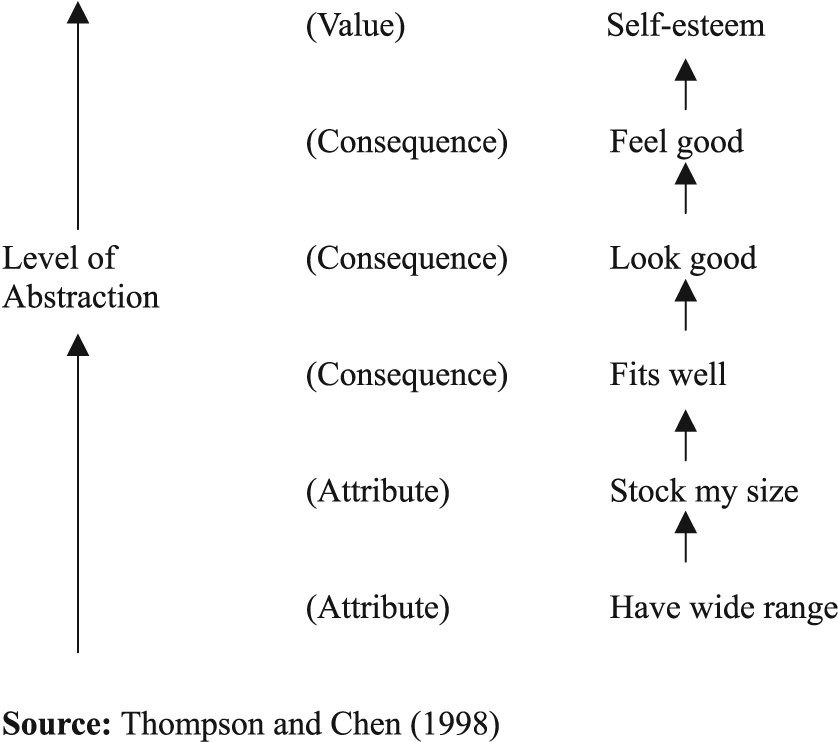
According to the Means End Chain theory, there is a hierarchy of consumer perceptions and product knowledge that ranges from attributes to consumption consequences to personal values, as follows:

  • attributes —At the top level of this hierarchy, attributes are most recognizable by individuals. Individuals recognize the attributes of a product or system easily. For example, “I like this car, because it is a convertible.”
  • consequences —In turn, the attributes have consequences for the individual. For example, the convertible makes its driver feel young and free. Each attribute may have one or more consequences for any given individual.
  • core values —Finally, each consequence is linked to a core value of the person’s life. For example, the sense of youth makes that driver feel attractive. (Hawley, M 2009)
Whereas the laddering technique can help marketers to ascertain their unique selling point (USP) and their positioning strategy. The means end theory shows in more detail the relationship between a product attribute and a core value. For more information on the means end theory LOOK HERE.

VALS 2

VALS-2 was developed by the US consulting firm Stanford Research Institute (SRI) as an improvement on its original VALS (introduced in 1978) - Marketing Essentials, 2008. It was designed to identify a persons: Values, Attitudes, and Lifestyles System. I have taken the VALS Survey and it showed that my primary VALS type is Experiencer, and your secondary type is Striver.

The primary VALS type represents your dominant approach to life. The secondary classification represents a particular emphasis you give to your dominant approach. Therefore; I understand things better when I experience things, and because I'm a striver I will do all I can to experience something.


Friday, 29 January 2010

Lecture 7 - Group Conformity, Opinion Leaders, & Peer Pressure

Group Conformity

An online dictionary defines conformity as:
"adjusting one's behaviour or thinking to match those of other people or a group standard"

There are lots of reasons why people conform, including the desire/need to fit in or be accepted by others and maintaining order in ones life. For example, when you go to class, do you sit in a chair like other students or sit in the aisle? Do you face the front of the room like everyone else or do you sit facing the back wall? Why? Well, according to Muzafer Sherif (he was one of the most influential conformity researchers in psychological history), "When the external surroundings lack stabile, orderly reference points, the individuals caught in the ensuing experience of uncertainty mutually contribute to each other a mode of orderliness to establish their own orderly pattern." (Sherif, 1996).

Firstly; we were told a story about monkeys, and how they conform to one another. This was because when new monkeys were introduced to the group, they were instant outcasts, and had to realise that they had to conform to the group and do what they say to be accepted.

Groups

A group is two or more individuals who: share a set of norms, have role relationships, and experience independent behaviours.

Groups influence the socialisation process. These influence what we learn and how we behave. This may provide the individual with the 'accepted' skills and habits necessary for participating within their own society.

Societies are formed through these main factors:
  • Shared norms
  • Customs
  • Values
  • Traditions
  • Social Roles
  • Symbols
  • Languages
From experience, I can agree that people tend to conform to groups through these shared norms. Since coming to Bucks New Uni I became part of the hockey society. Which has resulting in this group expended to be part of the huge sports society.
Some people may say our behaviour is undesirable... This can be shown with brands too. For example Burberry's iconic jackets, scarf, and caps have been mis interpreted by the public. This has had a huge impact on Burberry's brand - bringing it mass amounts of bad publicity. This is shown in a article by The Mail where they outwardly said that "The luxury brand with a chequered past, Burberry's shaken off its chav image to become the fashionistas' favourite once again". Obviously a crisis like this is rather hard to retrieve their original brand image.
To try and regain their original image, paper adverts were made using a very influential model - Kate were made targeting the more upper class of people. This was done through using Kate Moss. By using models with this status it gives the brand their status back.

Maslows Hierarchy of Needs

Maslows hierarchy of needs has a great deal to do with people conforming to groups, and becoming part of a chosen society. Maslow addresses the following factors:
  • Self Actualisation
  • Esteem needs
  • Belonging needs
  • Safety needs
  • Psychological needs
Obviously off all these are important factors to consider if you are a marketeer. They tend to realise that 'man is a social animal' and needs unconditional positive regard. As well as children who learn through conditional positive regard. The most important part of the hierarchy is the sense of BELONGING. This is because advertisers use this as a pivotal message in ad campaigns.

Social Comparison Theory - Festinger 1954

This theory suggests that there is a drive within individuals to look to outside images in order to evaluate their own opinions and abilities. These images may be a reference to physical reality or in comparison to other people. People look to the images portrayed by others to be obtainable and realistic, and subsequently, make comparisons among themselves, others and the idealized images.

Consumers are also subject to this behaviour. Consumers are extremely selective about who they use for benchmarks for their brands. In general, for social comparisons, people tend to choose a Co-Orientated Peer, or a person of the equivalent standing.

Group Behaviour depends on Perception

How do you perceive these pictures?


Everyone interprets different images individually, meaning our perspective differs from one another. This affects what groups we become part of as I have already mentioned that people make or join groups by having shared norms.

Group Behaviour

Similarly; to the monkeys another study was conducted at Stanford County Prison by a man called Zimbardo. This study can be found here. From this study you can easily recognise that because the participants knew how prison guards acted in real life, they immediately took these roles on. This then progressed to the other guards are they conformed as a group. Most people will conform to a group through positive reinforcement from other member of the group and the fear of negative sanctions.

Group Norms and Pressure

Everyone is subject to pressure within their chosen groups. This can be from group behaviour - so acting in a way they would not otherwise. Or the pressure to change they way they look. This is seen within both genders. For example males at a gym always try and out do one another by body building - which sometimes results in the use of steroids. And females ALWAYS have the pressure to look better to appeal to the males - which sometimes results in plastic surgery.


The main influence of groups is the acceptance of certain expectations of behaviour e.g norms, and rules. An individual can react to this pressure by: compliance, internalisation and identification, or counter conformity.

The link between Behaviour and Social Marketing

Social marketing became apparent when in the 1970's when Philip Kotler and Gerald Zaltman realized that the same marketing principles that were being used to sell products to consumers could be used to "sell" ideas, attitudes and behaviors. Kotler and Andreasen define social marketing as:

"differing from other areas of marketing only with respect to the objectives of the marketer and his or her organization. Social marketing seeks to influence social behaviours not to benefit the marketer, but to benefit the target audience and the general society."

This technique has been used extensively in international health programs, especially for contraceptives and oral rehydration therapy (ORT), and is being used with more frequency in the United States for such diverse topics as drug abuse, heart disease and organ donation.

This can be seen in most adverts nowadays. This video explains why social marketing is a must...


Summary


As you can see there are many factors that influence the way a person behaves whether it be individually or within a group. Marketers and advertisers have full taken advantage of this, enabling them to connect at a higher level with their consumers.

    Enterprise Week :)

    Enterprise Week

    Enterprise week offers a range of activities and events designed to provide business people and buddying entrepreneurs with a range of commercial opportunities, networking forums and challenges.Personally; this week increased my confidence in both myself and my academic abilities.

    The main event for myself was the 'Apprentice Challenge' as myself and some other course friends got together and made team...

    SMARTYPANTS

    Firstly; team SmartyPants had to find out who our sponsor for the challenge was. All sponsors were drawn out of a hat at the meeting at the Crown Plaza in Marlow. We were matched with Andrew from a finance agency. Once the meeting was over, he sat down with us and advised us on ways to raise money and the best ways to market ourselves. He gave us our initial investment of £50 and gave us his number as we both went our separate ways.

    The first task was to buy as many doughnuts as we thought we would need, and then sell them at a reasonable price in the Eden Centre High Wycombe. Eventually, our team decided to buy 200 jam doughnuts from leading supermarket Tesco. This was our last option as we wanted to get them at a discounted rate, but all other shops were far to expensive. This cost us £30. However, we did need to buy tissues and plastic gloves to serve them with. By then end of the day all our doughnuts had sold and we had raised £265.

    We were through to the next round! Our next task was to hold a stall in the Eden Centre selling any products of our choice. We decided that selling cakes would be fairly easy as we had already had experience in this through selling doughnuts. We also decided to make home-made Christmas cards, as not many places in High Wycombe sell them - so there was a niche in the market. Both Chris and myself thought it would be a great idea to get coffee to sell with the cakes, so we went to Starbucks and asked them to donate.

    Unfortunately; we were not able to sell this coffee but was able to give it out with our cakes, on the condition we used Starbucks cups, and sugar. Therefore offering Starbucks free marketing in return for then giving us coffee. This was a great selling point for us as people were more subjected to buy our cakes.


    Even though this task started fairly slow, we were fortunate enough to be outside Marks and Spencer - who were holding their annual 1p sale. So we instantly had a crowd to sell our products too. This task continued for 6 hours and raised us a total of £56.

    This enables us to get through the the semi-final stage of the event. Now we had to come up with an event plan, which we were to pitch to a panel of people who would have the deciding vote on what 2 teams out of the 4 would go through to the final - these would be the ones with the best business ideas. If we were to get through this we would get another £100 investment from Andrew to help fund our event. SmartyPants, decided to hold a James Bond Night in the Student Union where we would have poker tables, jelly vodka shots and many other attributes for the night. We all got very excited, and I believe this showed when pitching our idea. WE GOT THROUGH!

    Next was to make posters, tickets and a Facebook event page to inform the student audience of our event. These are shown below.

    I made 3 posters to cater to different peoples tastes:


    These were the tickets:
    This night was a success and we raised a total of £574.40 from our initial £150 investment. Thus, us winning the Apprentice Challenge of 2009 :) :)

    An advertising and marketing communication industry panel came into Bucks New Uni to talk to us. The panel consisted of:

    Obviously, these are huge companies to have talk to us, and all entail interesting anecdotes and experiences in the industry. The first thing they all have in common is that they have all embraced digital for advertisement. This raised the question whether straight advertisement works on sites such as Facebook or Twitter in the 21st Century? The answer stated by Sue Elms was “sometimes”. This is because “social sites are not being used to their full potential as they are not understood comcompletely, however when it is, it will be a phenomenon” (Sue Elms, 2009). An example of this was given about Maclaren having to announce a voluntary recall due to baby fingers been amputated in push chairs, Sue Elms suggested that other retailers such as: Mothercare and John Lewis should have been quicker to exploit this and advertise more heavily that there products were safer. But they “failed to respond quick enough and digital resources would have enabled them to do this”.


    It was said that there are too many digital immigrants in comparison to digital natives. The industry needs digital natives as they are experts in how the new digital era works- it’s their second nature. The industry needs them as they have seen digital develop and have used them whilst growing up; therefore they will not need to be taught the skills.


    The next point was whether the brand or product is more important in terms of advertisement? In the 21st Century advertising included publishing, creating and building the brand, this is mainly due to the role of television, internet and the consumer (Sue Ullerman, 2009). Advertising is there to make the consumer want the brand as it creates interaction between them both as well as shaping the product in the consumers head. This view suggests that advertisement is mainly focused on the brand and is only there to add value to the product itself. Advertising the brand rather than the product may also be due to the economic crisis as it is cheaper to advertise a brand rather than a product as it can be used for all products. For example, most people buy Apple because of the brand not the product. On the other hand George Hudson states “the power of the product is still valuable”, this is because it needs to live up to the expectations of the brand.


    The skills required in this industry are; to be passionate about the job, enthusiastic, innovative and have good communication skills. Which are attributes I hope to have in the near future.